Engineer. Researcher. Perpetually curious.Applied AI Labs @ AMD

Hey, I’m Abhinav.

Somewhere
between silicon
& software.

I work on AI for chip design. I’m interested in what happens when models meet real engineering: the tools, the tests, and the hardware underneath it all.

A few things I’ve worked on
Portrait of Abhinav Nandwani beside a lake
Abhinav NandwaniCE + CS · UW–Madison
Models → systems → siliconFind me on GitHub ↗

01 / Selected work

Ideas, with evidence.

Build it. Test it. Look closer.
01.A / Applied AI

AI that can do
the engineering.

At AMD’s Applied AI Labs, I work on coding-assistant evaluation, simulation-based feedback, and tools that help designers make sense of waveforms. The interesting question is how well an agent holds up on actual chip-design work.

Agent evaluationSimulationDebugging tools
01.B / Fault-aware AIResearch
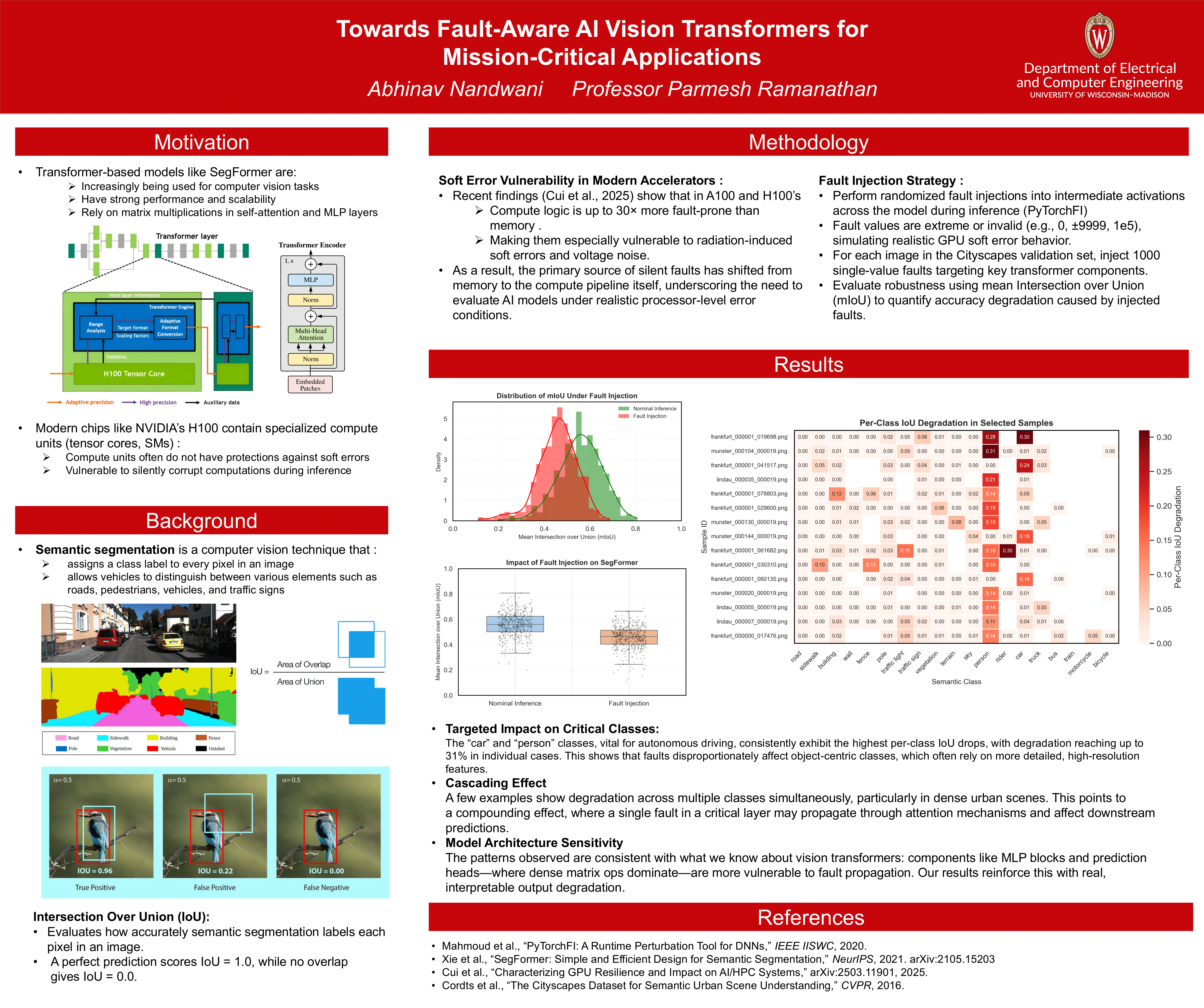
Research poster showing fault injection experiments in a SegFormer vision modelView full poster ↗

What happens when
the hardware gets it wrong?

With Professor Parmesh Ramanathan, I studied how GPU-style soft errors affect semantic segmentation, including safety-relevant classes like cars and people.

The UW research symposium ↗
01.C / Accessible computingPaper + CHI demo

Making virtual worlds
more accessible.

VRSight explores AI-driven scene descriptions for VR accessibility. The work includes a full paper and a CHI demonstration.

Find the research on Scholar ↗

02 / Building a community

SiliconBadgers

UW–Madison’s first chip design club

Chip design is
a team sport.

I help run SiliconBadgers, where students get hands-on with digital design, verification, and the chip-development process. We’re working on an open-source LLM inference accelerator, with teams tackling software, architecture, RTL, verification, and physical design.

I help shape the technical direction and turn it into concrete work for each team, from profiling llama.cpp to defining interfaces and building verification infrastructure.

One project. Many disciplines.
SoftwareArchitectureRTLVerificationPhysical design

Learning the whole path
from models to hardware.

03 / From the notebook

Working it out loud.

All writing ↗
APR042026

ML systems / Interactive explainer

What does RLVR
actually cost?

GPU throughput, training time, cloud pricing, and a calculator to see how the assumptions change the answer.

Read the note & try the estimator

04 / Learning resources

Open a terminal.
Follow the signal.

My practical guides to Synopsys on UW–Madison CAE. Real screenshots, terminal commands, GUI walkthroughs, and the code behind them.

Explore the resources ↗

05 / A little context

I like connecting
the layers.

My background is in computer engineering and computer science at UW–Madison. Before AMD, I worked in Professor Daifeng Wang’s lab on machine learning for genomics: large GPU clusters, large datasets, and efficient model adaptation.

That brought me to the questions I keep coming back to: how we train and serve models, how we know an agent is doing useful work, and what the hardware is doing underneath.

The résumé version ↗

Things I keep coming back to

Can we check its work?

Agents become interesting when they can act, get useful feedback, and try again. I care about the evaluations and engineering tools that make that loop meaningful.

Where does the time go?

Training, inference, data movement. I’m drawn to the practical work of making model stacks run reliably and efficiently at scale.

What’s happening underneath?

The model is one layer. The compilers, memory, and compute units underneath it decide how performance lands in the real world.

Always more to understand. ↗